Back to simulations Causal Loop Diagram

The Immigration Problem

A system-dynamics view of US illegal immigration. Rather than a single cause, the diagram shows the interlocking feedback loops that keep the system in motion — labor demand from US business hiring, wage differentials between rural Mexico and US illegal wages, enforcement pressure, and the rural Mexican economic investment that follows migrant remittances back home.

R · Labor-demand reinforcing
B1 · Enforcement balancing
B2 · Remittance balancing
D · Wage-differential driver
X · Cross-cutting
+ + + + + + + + + + + + + + + + + + + + + + + + + + Jobs for IllegalMigrants Wage Rate forIllegal Migrants US ConsumerCosts for Food Employed IllegalMigrant Population US Business HiringIllegal Migrants US Restaurant & Ag.Business Expansion Rate Income ofMigrants in the US Contribution toSocial Security BusinessReduction Rate PRESSURE TOENFORCE LAWS Investment inRural Mexico UnemployedMigrant Population US Illegal MigrantPopulation Fraction of Migrantscrossing border Wage RatioMexico → US Net Expansion ofBusiness in Mexico Cost to US forsocial services IllegalImmigration Rate PerceivedDesirability of US Businesses HiringRural Mexican Desirability of US Wages inRural Mexico Jobs toPopulation Ratio

23 variables, 32 causal links, four feedback loops. Hover an arrow to highlight it; double-bars (‖) on an arrow indicate a delay.

View original Stella® diagram (full 20-variable model)
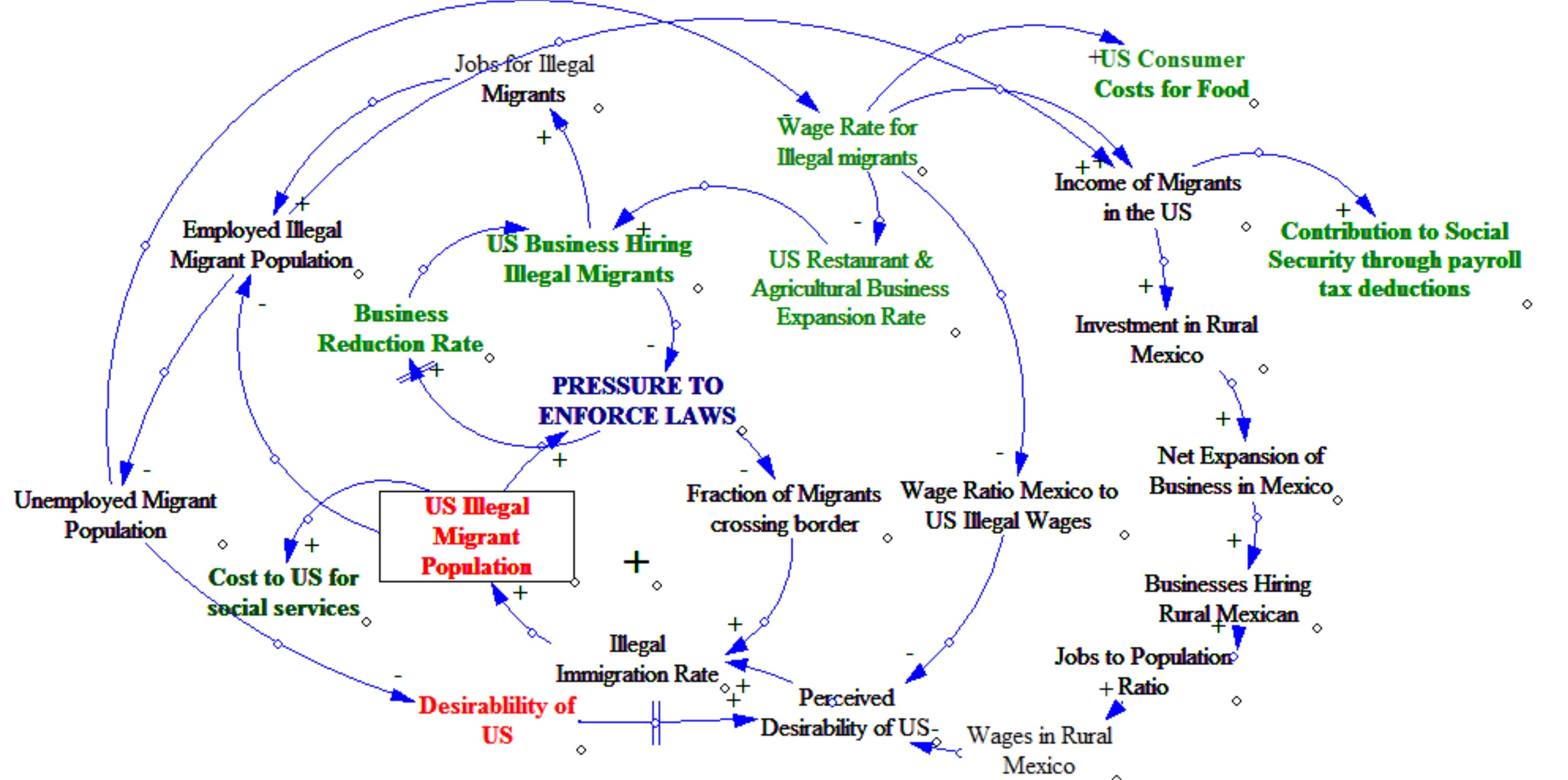
Original Stella causal loop diagram with the full 20-variable model.

Original Stella® model — Bob Bergman, AZ Decision Science.

How to read it

Each arrow shows the direction of causal influence. A + means the variables move in the same direction (more of one produces more of the other); a means they move in opposite directions. Loops formed by these arrows are either reinforcing (amplify behavior) or balancing (push toward equilibrium). The double-bar marks indicate a delay.

The core feedback loops

  • Labor-demand reinforcing loop: US Business Hiring → Jobs for Illegal Migrants → Employed Illegal Migrant Population → US Restaurant & Agricultural Business Expansion Rate → US Business Hiring. Cheap labor expands the businesses that depend on cheap labor.
  • Enforcement balancing loop: US Illegal Migrant Population → Pressure to Enforce Laws → Business Reduction Rate → Employed Illegal Migrant Population (down). Political pressure attempts to throttle hiring, lowering the migrant population.
  • Remittance / rural investment loop: Income of Migrants in the US → Investment in Rural Mexico → Net Expansion of Business in Mexico → Wages in Rural Mexico → Perceived Desirability of US (down) → Illegal Immigration Rate (down). Long-term, migrant earnings strengthen the Mexican rural economy and reduce the wage differential that drives migration in the first place.
  • Wage-differential driver: Wage Ratio Mexico to US Illegal Wages → Perceived Desirability of US → Illegal Immigration Rate. The bigger the wage gap, the higher the migration rate.

Why it matters

Policy interventions that target only one variable — enforcement alone, or wage rules alone — typically produce policy resistance from the other loops. A causal loop diagram makes the structure of the resistance visible before the policy is implemented, so stakeholders can debate the system, not just the symptom.

This is the kind of diagram we build during a system-dynamics modeling engagement — usually as the first step before turning the structure into a runnable Stella® simulation.

Have a system you'd like mapped?

Capacity loops, growth dynamics, policy resistance, customer churn, hiring & burnout — if it has feedback, we can model it.